THE SOFT POWER SKILLS FRAMEWORK
From Potential to Positive Impact
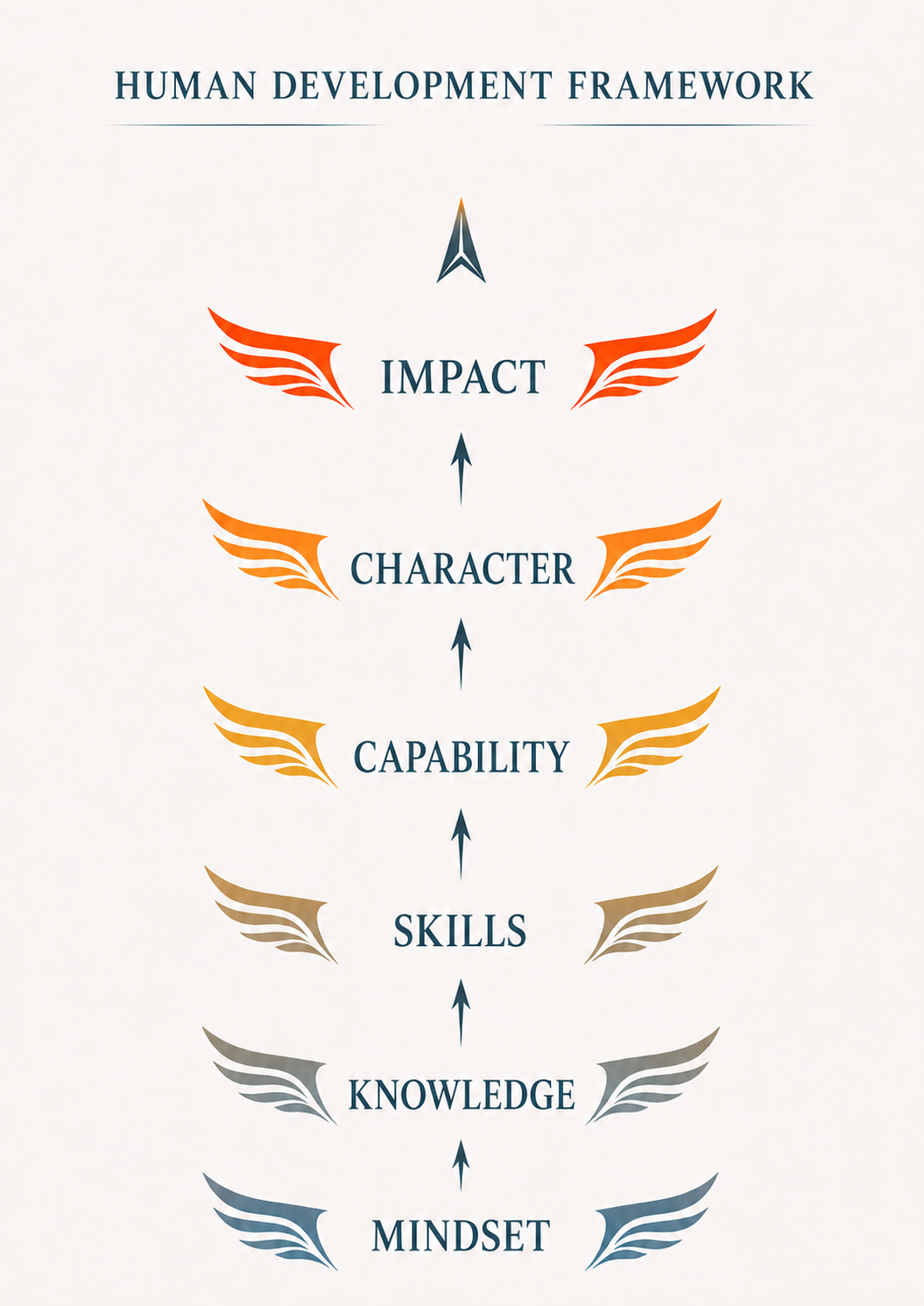
Human development is more than acquiring knowledge or learning isolated skills. It is the continuing process of developing how we approach learning, what we know, what we can do, how effectively we can apply it, how we choose to use it, and the difference our actions make.
Soft Power Skills organizes these connected dimensions of development through a six-part Human Development Framework.
Inside the Human Development Framework
The Framework brings six distinct but connected dimensions of development into one coherent structure. They are presented as a practical developmental progression, while recognizing that real human development is iterative, contextual, and mutually influencing.
The beliefs, motivations, and ways of approaching learning that shape how we respond to challenge, growth, and possibility.
Mindset
Who do I want to be?

Knowledge
What we know and understand.
What do I need to know?
The specific behaviors and techniques we learn and practice.
Skills
What do I need to be able to do?

Applying and integrating what we know and can do to accomplish goals in real situations.
Capability

How do I put it all together?
Character
How we choose to use what we are capable of doing—with judgment, responsibility, fairness, integrity, and courage.
How will I choose to use it?
Impact
How our choices and capabilities contribute to positive change for ourselves, other people, teams, organizations, and communities.
What difference will I make?
The progression is a practical way of organizing development—not a claim that people move through six fixed psychological stages.
Knowledge gives us concepts, principles, and possibilities. Skills give us techniques we can practice. Capability appears when we can integrate what we know and can do, exercise judgment, adapt to the situation, and perform effectively when the context changes.
A student may understand the principles of communication and still struggle to communicate when emotions rise. A team may know how planning works and still fail when information is incomplete. The developmental challenge is transfer: using learning effectively beyond the lesson.
Knowing Is Not the Same as Being Capable
From Knowing to Capability

Capability is what learning looks like when it works in the real world.
Character Directs Capability
Capability gives people greater power to act. Character concerns the direction of that power: the judgment, integrity, fairness, courage, responsibility, and concern for others that shape our choices.
Two people can possess the same technical or leadership capabilities and use them very differently. For Soft Power Skills, development is incomplete if growing capability is disconnected from the question of what kind of person we are becoming and what principles guide our actions.
Character Aims Us in the Right Direction
Capability Answers “Can I?”
Character Asks “How Will I Choose to Use It?”
From Capability to Impact
The final question is not only what we know or what we can do. It is what happens because of what we do.
Impact may be personal: greater agency, confidence, judgment, or resilience. It may be interpersonal: a better conversation, a stronger team, or a fairer decision. It may extend to a classroom, organization, family, or community.
The Framework therefore ends where action meets consequence. Development becomes meaningful when greater capability helps us contribute, help others succeed, lead more effectively, and create positive change.
Development Should Make a Difference
Impact Transforms Development From Me to We
One Philosophy, Three Movements

Inspire - Attitude
Growth begins with how we see possibility: curiosity, purpose, openness, confidence, humility, and the willingness to learn.

Inspiration becomes useful when people gain knowledge, practice skills, receive feedback, and develop the capability to perform in real situations.
Empower - Aptitude
Development becomes real through choice and action: applying capability with character, learning from consequences, and creating positive impact.
Change - Action
INSPIRE. EMPOWER. CHANGE! is more than a motto.
It fundamentally expresses the human development journey.
Development Requires Experience, Reflection, and Practice
How Development Happens
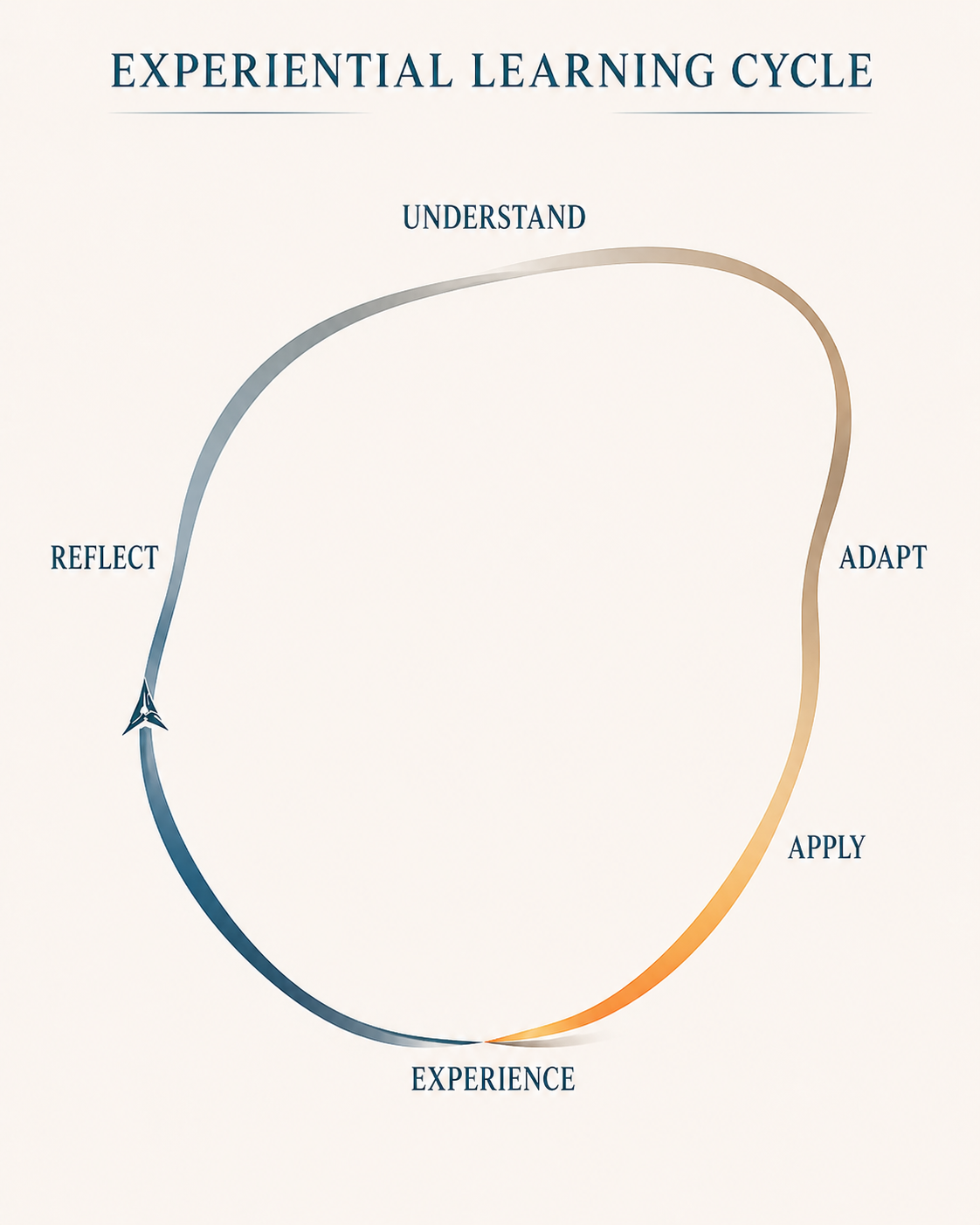
The Human Development Framework describes what develops. The Soft Power Skills Experiential Learning Cycle describes how structured experience, reflection, understanding, adaptation, and application can support better future action.
Experience creates something real to examine. Reflection and feedback help make sense of what happened. Understanding supports adjustment. Application tests whether the learning can transfer to another situation.
The Framework organizes evidence from across human development into a practical path for growth, action, and impact.
RESEARCH FOUNDATIONS
The Soft Power Skills Human Development Framework is an evidence-informed synthesis. It brings together ideas from learning science, motivation, skill development, transfer, human performance, character development, self-regulation, and behavior change.
We do not present it as a newly discovered psychological law, nor as six universal stages through which people develop in a fixed sequence. The Framework is the Soft Power Skills structure for organizing important dimensions of development and connecting them to purposeful action.
Research supports several of the distinctions at the heart of the Framework. Knowing is different from practiced performance. Practice, feedback, retrieval, and application can strengthen learning. Transfer to new situations is neither automatic nor guaranteed. Structured reflection and debriefing can improve learning and performance. Character and prosocial behavior can be developed, while choices and outcomes remain shaped by context. And development can contribute to meaningful personal, interpersonal, and organizational outcomes without guaranteeing them.
We use research to test, challenge, and refine the Framework—so that its claims remain grounded in evidence.
Learning & Skill Development
Learning Requires More Than Exposure
Knowledge is strengthened through processes such as retrieval, practice, feedback, spacing, modeling, and application. Knowing something and being able to perform it are related—but not identical.
Transfer & Capability
Transfer Is the Real Test
Skills practiced in one setting do not automatically transfer to another. Capability requires integration, judgment, adaptation, and effective performance when circumstances change.
Experience & Reflection
Experience Becomes More Powerful When It Is Examined
Well-designed active and simulation-based learning can be highly effective. Structured reflection, feedback, and debriefing can help participants make sense of experience and improve future performance.
Character, Action & Impact
Development Matters When It Influences Action
Education and development can influence prosocial behavior, self-regulation, purposeful action, and leadership outcomes. But behavior and impact also depend on context, opportunity, systems, and the choices people ultimately make.
Evidence informs the Framework. Experience puts it into practice. Reflection helps us improve it.
Framework in Practice
One Framework, Different Contexts
For Educators & School Leaders — Develop the human capabilities of the adults who intentionally shape learning environments, team climate, feedback, leadership, and school culture.
For Students — Develop the human capabilities needed to learn, collaborate, communicate, make sound decisions, lead, and contribute.
For Organizations — Apply the same developmental architecture to leadership, teamwork, human performance, decision-making, communication, and continuous improvement.